
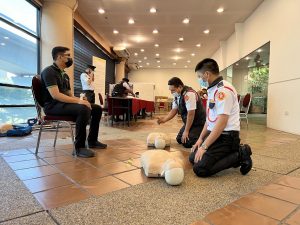
What Are the 2025 AHA CPR Guidelines?
The 2025 American Heart Association Guidelines for Cardiopulmonary Resuscitation and Emergency Cardiovascular Care provide evidence-based recommendations for responding to cardiac arrest, respiratory arrest and other life-threatening emergencies.
The 2025 AHA Adult BLS Guidelines were developed from updated evidence reviews and supersede the previous 2020 Adult BLS recommendations unless a specific recommendation was carried forward.
What Is CPR?
CPR stands for Cardiopulmonary Resuscitation.
CPR is an emergency procedure performed when a person is in cardiac arrest.
For an adult who is unresponsive and not breathing normally, immediate CPR and activation of the emergency response system are critical.
Early high-quality CPR and prompt defibrillation are among the key interventions for improving outcomes following adult cardiac arrest.
Adult CPR: What Should You Do?
When you find an unresponsive adult, follow your training and the appropriate emergency response procedure.
1. Check for Safety
Before approaching the casualty:
Check the scene for danger.
Make sure it is safe for you, the casualty and others nearby.
Do not put yourself at risk while attempting a rescue.
2. Check for a Response
Check whether the person responds.
Tap the person and shout.
Ask:
“Are you okay?”
If there is no response:
Call for help and activate the emergency response system.
In Malaysia, call:
999
If you are a lone responder, the 2025 AHA Adult BLS guideline recommends activating the emergency response system first and then immediately beginning CPR for an adult in cardiac arrest.
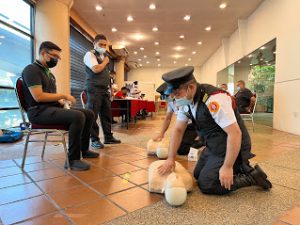
3. Check Breathing
Determine whether the person is breathing normally.
If the person is:
- Unresponsive
- Not breathing normally
treat the situation as cardiac arrest and begin CPR.
Important:
Gasping is not normal breathing.
Abnormal gasping can occur during cardiac arrest and should not be mistaken for normal breathing.
4. Start CPR
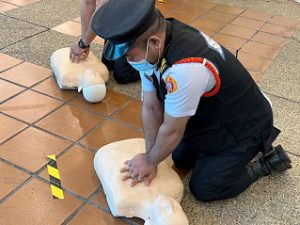
Begin chest compressions as soon as cardiac arrest is recognised.
Place your hands on the:
Centre of the chest
over the lower half of the sternum.
Position yourself so that you can perform effective chest compressions.
30 Chest Compression
Rescue Breaths
For trained rescuers providing conventional CPR:
Give 2 breaths after every 30 chest compressions.
Give each breath with enough volume to produce visible chest rise while avoiding excessive ventilation. The 2025 AHA Adult BLS guideline specifically emphasises providing enough tidal volume to produce visible chest rise while avoiding both inadequate and excessive ventilation.

CPR Guidelines FAQ
What are the latest AHA CPR guidelines?
The latest AHA CPR and ECC guidelines are the 2025 American Heart Association Guidelines for Cardiopulmonary Resuscitation and Emergency Cardiovascular Care.
What is the CPR compression rate for adults?
The recommended adult chest compression rate is 100–120 compressions per minute.
How deep should adult CPR compressions be?
For an average adult, compress to at least 5 cm, while avoiding excessive depth greater than 6 cm.
What is the CPR ratio for adults?
For conventional CPR without an advanced airway, use 30 chest compressions followed by 2 breaths.
Where should I place my hands during CPR?
Place your hands over the centre of the chest, on the lower half of the sternum.
Should I use an AED?
Yes. An AED should be used as soon as it is available, following the device’s instructions.
What if I don’t know how to give rescue breaths?
For an adult or teenager who suddenly collapses outside a hospital, Hands-Only CPR is an important option for untrained or unwilling bystanders.
Is gasping normal breathing?
No. Abnormal gasping should not be mistaken for normal breathing. An unresponsive person who is not breathing normally should be treated as being in cardiac arrest.